Booked identity
Have the exact booked name, booking number, current facility, and housing location if it is shown.
Home / Directory / California / San Diego jail health and safety concerns
HEALTH · Family guide
Use the dated local instructions below for this task. Confirm current housing and case assignment before acting; the earlier directory remains available below.
For San Diego County Sheriff jails. Youth, state, federal, and immigration custody use separate rules.
JAIL411 / FAMILY FIELD GUIDE
Sources reviewed
Seven active adult Sheriff jail facilities; county orientation and other custodians are separate.
Save the booking number and module; call 619-409-5000 if the record is unclear.
Onsite visits, SmartInmate video, printed email and commissary use different processes.
Check the module reservation, early arrival, parking or final transport and pickup location.
Get information to clinicians, request accommodations and report harm.
For a person in custody who may be suicidal, withdrawing, seriously ill, injured or without essential medication, call 619-409-5000 now, select the current facility, and ask for the Watch Commander and health staff. State that this is an urgent safety or medical concern, provide booked name, booking number, current housing if known, what happened and when, and your callback number. Ask that the information reach the responsible clinician and that an immediate welfare assessment be considered. Do not leave an urgent concern only in ordinary inmate email or an unmonitored website form. A person witnessing an emergency outside the jail should use emergency services.
The jail’s nurses screen people before acceptance. The public plan says sick-call requests are reviewed by a registered nurse within 24 hours; that is a review standard, not a promise of a clinic appointment within 24 hours. The person should tell a deputy immediately about an urgent condition and use the housing healthcare-request process for continuing needs.
Sources: Sheriff: health communication and consent · reviewed 2026-09-28 · Sheriff: Public Information Plan, updated June 30, 2025 · reviewed 2026-09-28 · Sheriff: active detention facilities · reviewed 2026-09-28
Privately supplied medicines are generally not administered in jail. Jail clinicians prescribe through the contracted pharmacy. Give health staff the medication list and prescribing contact; do not mail pills, deliver them at a visit or assume a sealed prescription bottle will be accepted. For eyeglasses, hearing aids, dentures, orthopedic devices or other essential equipment, ask health staff to approve the specific item and explain the delivery point and documentation first. A current facility-by-facility public acceptance procedure was not verified.
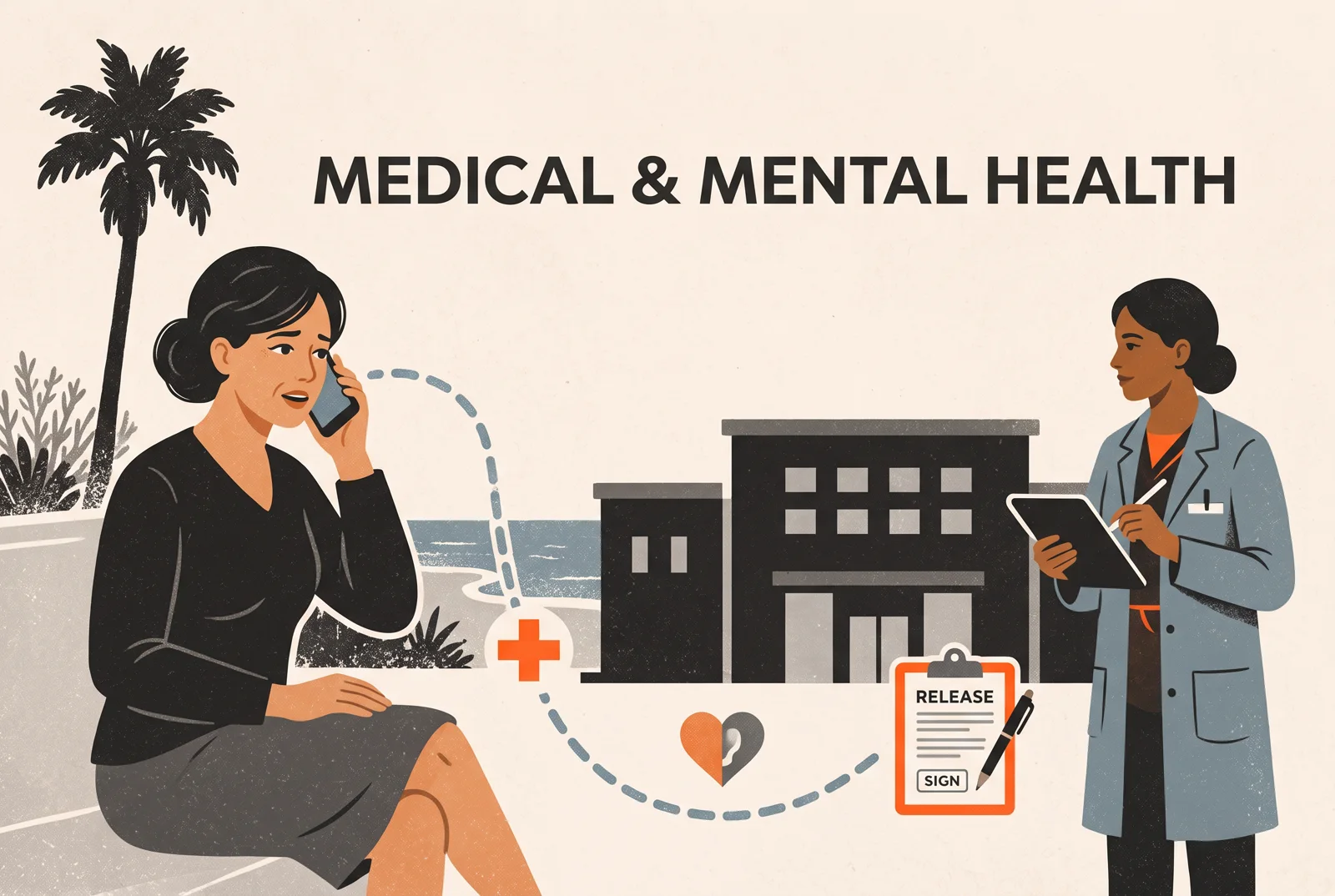
Family can provide health information even when staff cannot disclose information back. To authorize disclosure, the person must sign a Release of Information naming you and your phone number. English and Spanish forms and instructions are on the Sheriff health page. Ask what the signed authorization covers and how it reaches the correct clinician; being a relative does not itself authorize access to the medical chart. Do not assume a custody information release also releases medical records.
Private physicians cannot examine patients inside the jail under the public plan. Medical Administration may approve outside private-provider appointments after review, with provider, testing and transportation costs prepaid; contact health staff before arranging anything. Ask for disability accommodations through the facility and ADA program, including communication access, assistive devices and suitable housing. For family education and support, NAMI San Diego’s helpline is 619-543-1434, Monday–Friday, 9:00 AM–5:00 PM; it is not the jail’s urgent response line.
Sources: Sheriff: health communication and consent · reviewed 2026-09-28 · Sheriff: Public Information Plan, updated June 30, 2025 · reviewed 2026-09-28 · Sheriff: disability accommodations · reviewed 2026-09-28 · NAMI San Diego: family support contacts · reviewed 2026-09-28
Hospital transport dates and locations are withheld for security. Special hospital visits may be approved for labor, childbirth, postpartum recovery or grave illness. Start with the Watch Commander at the person’s housing facility through 619-409-5000; register there and obtain an approved hospital visit pass before going to a hospital. Bring that pass and proper ID for the assigned deputy.
The plan permits 2 visitors for 30 minutes, 2 visits per week Sunday–Saturday, subject to hospital visiting rules. Visitors may not give the person any items. Any exception requires Watch Commander approval. A pregnant person may choose a support person for labor, childbirth and postpartum recovery, with approval. For the named hospital guard units at Tri-City Medical Center or Alvarado Hospital, the plan directs approval to Vista’s Watch Commander. Confirm the currently assigned unit through custody staff; the plan’s hospital names are not a locator or permission to arrive unannounced.
Sources: Sheriff: Public Information Plan, updated June 30, 2025 · reviewed 2026-09-28 · Sheriff: health communication and consent · reviewed 2026-09-28
A person in custody may grieve conditions or treatment, including health care, classification, programs, phones, mail, visits, food, clothing, bedding and discipline. The public plan allows forms J-22/J-22A or any written complaint, submitted to staff or the secure grievance box. Write the specific event, date, location, people involved, attempted resolution and requested remedy; keep a copy or the tracking details.
The published response standard is 7 calendar days. The process escalates through a supervisor to the facility commander’s final level. Ask housing staff for current submission/appeal deadlines and the next level if no response arrives; those exact filing deadlines were not verified in the reviewed public material. A family complaint is not necessarily a substitute for the person’s own grievance or a court deadline. Bring unresolved urgent health or safety risks directly to the Watch Commander rather than waiting for a routine written response.
The Sheriff’s PREA policy prohibits sexual abuse and sexual harassment. The person can report to a deputy, supervisor or health staff; a family member with suspected abuse should call 619-409-5000, ask for the Watch Commander and state that it is a sexual-abuse/PREA report. Give the person’s identity, location and immediate protection needs. Ask for the reporting reference and route to the investigator; do not investigate or confront another incarcerated person yourself. The reviewed page did not establish a separate current family PREA hotline, so no unverified number is listed.
Sources: Sheriff: Public Information Plan, updated June 30, 2025 · reviewed 2026-09-28 · Sheriff: sexual-abuse reporting / PREA · reviewed 2026-09-28 · Sheriff: active detention facilities · reviewed 2026-09-28
For a complaint about Sheriff personnel, submit the Sheriff’s complaint form, report at a facility, or contact Internal Affairs at 858-974-2065; mailing address: P.O. Box 939062, San Diego, CA 92193. Give dates, facility, names if known, witness/contact details and supporting documents. Keep a copy and ask for a reference number. Use an immediate custody safety call for a present danger; a website submission is not a real-time response.
The independent Citizens’ Law Enforcement Review Board (CLERB) accepts complaints at 1600 Pacific Highway, Suite 034, San Diego, CA 92101-2422, 619-238-6776, clerb@sdcounty.ca.gov. Its own current page takes precedence over the older 555 W. Beech address still shown on a Sheriff page. CLERB accepts collect calls. A complaint must be written and signed under penalty of perjury; anonymous complaints are not accepted. Use its Complaint Form and Request/Agreement, and a medical release for an injury complaint. If you cannot print, email the complaint and mailing address so staff can prepare forms for signature.
CLERB generally requires filing within 1 year; its page excludes time the complainant was incarcerated or incapacitated from that calculation. Contact CLERB promptly for your deadline and jurisdiction. Its current authority page discusses detention health-provider oversight while older wording on another section is narrower; ask staff to assess a contractor/medical complaint instead of assuming it is excluded. CLERB review does not change a criminal case, award release or replace counsel’s legal remedies.
Sources: Sheriff: public complaints and Internal Affairs · reviewed 2026-09-28 · CLERB: complaint process and current office · reviewed 2026-09-28 · CLERB: current authority · reviewed 2026-09-28
This section preserves the earlier Jail411 directory information, including historical figures and contacts. Use the dated, sourced family guide above for the instructions covered there. Other local facilities have their own rules.
Call (619) 409-5000, select the current facility, and explain that you need to communicate a medical or mental-health concern. To receive medical information, the incarcerated person must sign a Release of Information form naming you and your phone number.
Tell the facility what you know about symptoms, medication, behavior, timing, and risk.
To receive medical or mental-health information, you must be named on a signed Release of Information form.
Before you start
Use the current booking information for this person and this facility.
Have the exact booked name, booking number, current facility, and housing location if it is shown.
Write down the condition, medication name and dose if known, recent behavior, symptoms, and why the concern is time-sensitive.
Give staff a reliable phone number. Do not post medical or custody details publicly.
Step by step
The current facility—not a general web form—controls the immediate handoff to custody or health staff.
Check Who’s in Jail immediately before calling because people can move between facilities.
Dial (619) 409-5000, select the facility, and say whether the concern is medical, mental-health, medication-related, or an immediate safety concern.
Provide the booked identity, known diagnosis or medication details, observed behavior, timing, and your callback number. Avoid speculation.
Facility staff can tell you the current method for records, medication information, or a written concern. Do not mail medication to the jail.
The incarcerated person must sign the Sheriff’s Release of Information form and name you as the authorized recipient before staff can release medical or mental-health information.
Know the limits
These details apply to the San Diego County Sheriff system and may change after a transfer.
Select the current facility from the shared custody-information line.
The incarcerated person must name the person authorized to receive information.
The Sheriff publishes Release of Information instructions and forms in both languages.
For an immediate emergency happening outside a detention facility, use emergency services.
Common problem
Family can provide information, but staff may be unable to confirm treatment, diagnosis, medication, or appointments without the person’s signed authorization.
Worth knowing
The Sheriff’s medical and mental-health page lists NAMI San Diego as a community support option for families and friends.
One last confirmation can save a wasted trip.
Next task
Use a facility guide for building-specific details or choose another family task.
Confirm schedules and service availability before traveling or paying. Jail411 does not hold custody records or process funds.
Practical guides for calls, visits, mail, money and release.