Mule Creek is a CDCR state prison in Ione. Confirm the person’s current facility and CDCR number before you plan a visit, send money or address a letter. Use the visiting, phone, mail and money instructions below for Mule Creek.
CDCR Infrastructure Master Plan, Appendix 1 (May 2026), period ending April 30, 2026
About Mule Creek State Prison
Mule Creek State Prison is a California Department of Corrections and Rehabilitation institution in Ione, Amador County. It opened in 1987 and houses people across security Levels I through IV.
The prison has six housing facilities. A, B and C are the original facilities; D and E are part of the newer Infill Complex. The Minimum Support Facility is outside the main fence.
As of April 30, 2026, Mule Creek reported a population of 3,752 people, or about 3,750, compared with its design capacity of 3,284.
Mule Creek is in Ione, east of Sacramento. Open directions to check the drive from your starting point and allow for current traffic and road conditions.
Nothing below works without two things: confirmation that the person is at Mule Creek State Prison, and their CDCR number. Book a visit without them and you will be turned away; post a letter without the number and the mailroom cannot route it.
CDCR's public search covers people in CDCR custody. A disclaimer must be accepted before searching, and CDCR states the tool is informational rather than an official record. County jail populations are held separately.
This is what the institution publishes, in the order you will meet it: when visits run, how to get approved, how to book, when to arrive, and what you may carry in.
Friday12:00 p.m. to 6:30 p.m. No visitor processing after 5:30 p.m.
Saturday8:30 a.m. to 3:00 p.m. No visitor processing after 2:00 p.m.
Sunday8:30 a.m. to 3:00 p.m. No visitor processing after 2:00 p.m.
Holidays: New Year's Day, Independence Day, Thanksgiving Day and Christmas Day.
Count: Close-custody count can stop movement roughly 11:15 a.m. to 12:45 p.m. You can be processed and still wait for the person to reach the visiting room.
Check the status for the person’s facility or yard on the day you travel. Visiting can change even after you make a reservation.
Caveat. Visiting status is the most perishable thing on this page. Check CDCR's visiting status page for Mule Creek on the day, not the week before.
Check the correct yard. Mule Creek runs six separately controlled facilities: A, B, C, D, E and the Minimum Support Facility. A modified program can suspend visiting on one yard while the rest continue. Know which facility the person is on and confirm that yard is visiting before you set out.
1
Get approved
You have to be approved before you can book. The incarcerated person first sends you a signed CDCR Form 106 Visiting Questionnaire. Complete that copy, then mail it directly to Mule Creek's visiting office.
Send it to: Mule Creek State Prison, ATTN: Visiting, P.O. Box 409099, Ione, CA 95640.
On the envelope: Put no information about the incarcerated person on the envelope, and write "Visiting form inside" on it.
What not to do: Do not mail the completed questionnaire back to the incarcerated person. Send it directly to Mule Creek's visiting office at the address above.
From outside the US: Attach a copy of your valid passport to the questionnaire. Without it the questionnaire is returned.
Questions: General visiting and application questions: (209) 274-4911 extension 5410.
Use CDCR’s Visitation Scheduling Application to reserve a contact visit. Phone and email do not book contact appointments. Approved visitors may also try a walk-in during regular visiting hours if space is available. A walk-in is not a reservation and does not receive the scheduling application’s cancellation notice. Call the institution and check current visiting status before traveling without an appointment.
The scheduling application is at cdcr.gtlvisitme.com/app, which is the address CDCR publishes for it.
For a Friday visitOpens the previous Thursday at 6:00 a.m.Closes the previous Sunday at 11:59 p.m.
For a Saturday visitOpens the previous Friday at 6:00 a.m.Closes the previous Tuesday at 11:59 p.m.
For a Sunday visitOpens the previous Saturday at 6:00 a.m.Closes the previous Wednesday at 11:59 p.m.
Best practice: Book as soon as the window opens. Slots go quickly, particularly for Saturday and Sunday.
Your first visit: Use Claim Account in the scheduling application with your name, date of birth and email. It links your account to the people you are already approved to visit.
Non-contact and restricted-housing visits
Non-contact and restricted-housing visits are booked a completely different way: by telephone or email, direct to the institution. The scheduling application is not used for them, and walk-ins are not allowed at all.
How to book: Call (209) 274-4911 extension 5410, Monday to Thursday 8:00 a.m. to 12:00 p.m., or email MCSPvideovisiting@cdcr.ca.gov during those same hours.
When: Only in the week of the weekend you want. Booking further ahead does not work.
Times: One hour each. Friday: 1:00 p.m., 2:00 p.m., 3:00 p.m., 4:00 p.m. and 5:00 p.m. Saturday and Sunday: 9:00 a.m., 10:00 a.m., 11:00 a.m., 12:00 p.m. and 1:00 p.m.
Include: The incarcerated person's full name and CDCR number; every approved visitor's full name, date of birth and valid ID type; how many visitors (three maximum); each visitor's relationship to the person, email address and phone number; and the appointment date and time you want.
Subject line: Put "Non-Contact Visit Request" in the subject line.
Confirmation: Visiting emails a confirmation, which can take a day or two.
Do not email a request and then telephone about the same one. CDCR asks you to pick one route.
3
Arrive, and report to visitor processing
Arrive about an hour before your scheduled visit, but not earlier than that. CDCR states that visitors are not allowed onto prison grounds more than one hour before visitor processing starts.
Processing closes first: Processing closes well before visiting ends: 5:30 p.m. on Friday, 2:00 p.m. on Saturday and Sunday. Arriving after those times means no visit, whatever your reservation says.
Before you set out: CDCR asks visitors to check road conditions on quickmap.dot.ca.gov or the QuickMap app before setting out because closures and chain control are a real risk on the routes into Ione.
Parking: Park in the lower parking lot, marked VISITOR PARKING. CDCR names that lot specifically for visitors and keeps it separate from staff parking.
Accessible parking: Designated accessible visitor spaces are provided under CDCR statewide visitor-parking rules.
Vehicle searches: Vehicles on prison grounds are subject to inspection. Staff may inspect the exterior, view the interior from outside, inspect the trunk on entry or exit, and use narcotics-detection dogs.
Do not leave prohibited items in the vehicle. CDCR states that bringing weapons or illegal drugs onto prison property is a felony.
Where to report: Use the Highway 104 address and follow signs for Visitor Parking, Visitor Processing and the Visitor Center. Park in the lower lot marked Visitor Parking. After processing, staff direct you to the correct visiting room.
Friends Outside Visitor Center, on site, (209) 274-4749. Hours: Friday 11:00 a.m. to 7:00 p.m.; Saturday, Sunday and designated holidays 8:00 a.m. to 4:00 p.m.; Thursday 10:00 a.m. to 2:00 p.m. administrative only. These are VISITOR CENTER hours, not prison visiting-room hours. The distinction matters.
4
Bring the right things, and only those
Allowed in
Assume everything stays in the vehicle unless CDCR specifically permits it. No phones, smartwatches or electronics, no weapons, no drugs or tobacco.
One pair of eyeglasses; one handkerchief or a small unopened packet of tissues (no bandanas); one non-metallic comb or hairbrush with no pointed ends or detachable parts; and an Indian medicine bag, subject to inspection and approval.
$100 per adult visitor and $50 per minor, in quarters, one-dollar bills and five-dollar bills only. Nothing else is accepted, and the money is for the vending machines.
One transparent coin purse, no more than two compartments, no bigger than 6 by 8 inches.
Two keys on a ring with nothing else attached. One of them may be an electronic car key.
Plain white t-shirts and dress shirts. Sports team logos, as long as nothing is personalized. Leggings, provided the top or dress covers the lower body and is not sheer. Dresses no more than two inches above the knee.
Stays in the car
Blue denim or blue chambray; forest-green bottoms with tan tops; camouflage; law-enforcement or military-style clothing; strapless, halter, bare-midriff, sheer or transparent clothing; very tight or form-fitting clothing; skirts, dresses or shorts more than two inches above the knee, front and back; anything exposing breasts, genitalia or buttocks; wigs, hairpieces or extensions without prior approval; hats or gloves unless authorized or weather-appropriate; shower shoes.
Avoid underwire bras and metal-heavy clothing; they will stop you at the detector.
Identification: Every adult must present a current, unexpired photo ID.
How many may visit: Maximum five visitors at one time for a regular in-person visit.
Visitors under 18: Every visitor under 18 must be accompanied by an approved adult. A parent brings the child’s certified birth certificate. A legal guardian brings the certified birth certificate and proof of guardianship. Another approved adult must bring the certified birth certificate and original notarized consent from the parent or legal guardian. The consent must identify the incarcerated person, the accompanying adult and the visit dates, and must be renewed annually.
Wearing orange: Orange tops and orange bottoms are each fine on their own. It is wearing them together that is not allowed.
If you are turned away: If an officer says your clothing is unacceptable and you believe you have complied, you may ask to speak to the Visiting Sergeant or Lieutenant, who makes the decision. That is a stated right, not a favor.
Video visits and cost: Weekend visiting at MCSP is in person. CDCR discontinued routine weekend video visiting at adult institutions in July 2023; video visiting continues principally for conservation camps.
CDCR’s family-visiting program offers approximately 46 consecutive hours in a private unit for eligible people and approved immediate family members or registered partners. Eligibility, available space and an institution waitlist apply. This is separate from regular contact visits booked through the scheduling application.
Mule Creek has participated in family visiting, but that does not confirm an overnight space is available now. Call visiting staff at (209) 274-4911, extension 5410, about current availability. The incarcerated person should ask their assigned counselor or Family Visiting Coordinator about eligibility and an application. The coordinator supplies family paperwork and scheduling and meal instructions.
Relationship alone does not establish eligibility. Custody classification, disciplinary history and other restrictions can affect approval. Ask the counselor to apply the current eligibility rules to the person’s circumstances.
Mule Creek now uses Securus for calls and tablets. Standard audio calls are free to both parties, and you do not need an online account to receive them. The incarcerated person initiates the call; calls are limited to 15 minutes. The prison switchboard cannot connect you directly to a housing unit.
Monitoring: Institutional calls may be monitored or recorded, except properly arranged confidential legal calls.
Tablet messages, photos and video
Tablet messages, photos and video use separate services. Create an account through Securus or the Securus Mobile app. For paid video, set up and fund AdvanceConnect, register for Video Connect and enable Allow Video Calls. Check the services and charges shown for Mule Creek before paying.
CDCR lists video at $0.10 per minute, an e-message at $0.03 and an incoming photo at $0.03, with 30 free video minutes each month. These paid tablet services do not make standard audio calls chargeable. Messages, photos and media from ViaPath do not transfer to Securus.
Before anything else you need the person's CDCR number, from California Incarcerated Records and Information Search (CIRIS), and their current location from CDCR's facility locator. CDCR then lists three routes. Electronic funds transfer through one of its vendors: GTL/ConnectNetwork, JPay, or Access Corrections. A lock box deposit, which CDCR states carries no fee when sent by money order, personal check or cashier's check: complete the Money Order Deposit Form with the sender's name and address, make the payment payable to JPay, and mail it to JPay, 2202 South Figueroa St, Box #3001, Los Angeles, CA 90007. CDCR caps this at $999.99 per money order, holds personal checks for ten business days, and warns that any letter or note enclosed with a payment will be discarded. Or send a check or money order to the institution itself. Vendor fees vary by amount and method, so check the vendor's own figure before you send.
GTL/ConnectNetwork, JPay and Access Corrections are CDCR’s vendors for electronic trust-account deposits. Securus is used at Mule Creek for communication services. Funding a Securus communication account does not deposit money into the person’s CDCR trust account.
Fastest
Electronic Funds Transfer through GTL/ConnectNetwork, JPay or Access Corrections. Usually posts in about 1 to 3 days. The vendor charges a transaction fee.
No fee
The JPay Lock Box carries no processing fee. Send a money order, personal check or cashier's check with the deposit form, payable to JPay, to: JPay, 2202 South Figueroa St, Box #3001, Los Angeles, CA 90007. Paper takes substantially longer to clear.
⚠️ If the person owes court-ordered restitution, money deposited can be garnished. CDCR applies 50 percent toward qualifying restitution plus an administrative assessment. Its materials describe the total deduction as potentially 55 percent. Direct victim restitution orders are generally collected before restitution fines.
Writing to someone here
Use CIRIS to confirm the current prison. Ask the institution or its Public Information Officer for the correct housing and mailing details. Put the person’s full name and CDCR number on the envelope, with the prison name, correct P.O. box and ZIP code. Confirm the destination again after a transfer.
Postal address
Full committed name · CDCR number · housing Mule Creek State Prison (MCSP) P.O. Box 409099, Ione, CA 95640
You may send photos in first-class mail. Do not send Polaroids, negatives, slides, photos with attached backing or frames that cannot be searched. Photos must also meet CDCR’s content and property rules.
Books must be softcover and shipped directly by a publisher, bookstore or book distributor that does mail-order business. Do not repackage books at home and mail them yourself. Ask the institution about special-purchase procedures and possession limits before ordering; CDCR’s published possession limit is ten books.
Use the correct name, CDCR number and mailing address, and check the contents before sending. Prohibited items and incorrect recipient details can cause rejection or delivery problems.
Families cannot mail quarterly packages directly to the prison. Use CDCR’s approved-vendor list. The current posted general list names Access Securepak, Mike’s Better Shoes, The Vitamin Outlet, Union Supply Direct, Walkenhorst’s and Emma’s Premium Services. The list is titled 2025; use CDCR’s links to check it before ordering.
First confirm the person’s current prison, CDCR number, package eligibility and remaining allowance with the person or institution. Allowances depend on privilege group and restrictions; not everyone may receive one package each quarter. On the vendor’s site, select Mule Creek and the correct recipient and privilege group, then check the allowed items and delivery quarter. Keep your receipt.
The maximum gross weight is 30 pounds, including packaging, and the maximum dimensions are 24 by 24 by 24 inches. Overweight packages are returned. A package order is separate from a deposit to the person’s trust account. Vendors are independent businesses; approval is not a CDCR purchase guarantee.
There are no hotels in Ione. Jackson and Sutter Creek, roughly 8 to 12 miles east, are the practical bases for anyone staying overnight to visit Mule Creek. Both are historic Gold Country towns with restaurants and easier access than Ione.
Call the Visitor Center at (209) 274-4749 before relying on transportation from a local transit terminal. Confirm whether service is available for your visit and arrange the rest of your trip before leaving.
Note. Confirm this service is running before planning a visit around it.
Where to stay
Best Western Amador Inn200 S State Highway 49, Jackson, CA 95642 · about 10 milesFree hot breakfast; seasonal outdoor pool; free WiFi; free parking; pet-friendly (fee and restrictions); smoke-free; near downtown historic Jackson(209) 223-0211
Holiday Inn Express & Suites Jackson101 Clinton Road, Jackson, CA 95642 · about 10 milesFree hot breakfast; fitness center; free WiFi; free parking; outdoor pool (some listings note heated); smoke-free; elevator; NOT pet-friendly; near downtown Jackson and Jackson Rancheria Casino(209) 257-1500
The Murieta Inn & Spa7337 Murieta Drive, Rancho Murieta, CA 95683 · about 12 milesUpscale boutique property; full-service spa; heated outdoor pool; on-site restaurant and lounge; fitness center; free WiFi (resort fee may apply); pet-friendly; microwave and fridge in rooms(916) 354-3900
Most of these include free breakfast and free parking, which matters when a visit means an early start. Distances are approximate driving distances and vary by route. Confirm rates, pet policies and availability before booking.
Early openers are what matter. Visiting asks you to arrive an hour early and weekend processing closes at 2:00 p.m., so the early openers are the ones that matter: Star Donuts in Ione from 5:30 a.m., and Mel & Faye's Diner in Jackson from 5:00 a.m.
Somewhere to eat
Place
What and when
Phone
Star Donuts22 CA-104, Ione, CA 95640 · 2-3 miles
Donuts, breakfast sandwiches, bagels, coffee. Counter service. Typically 5:30 a.m. to 2:00 p.m. daily
MCSP has historically operated a CDCR-funded Visitor Center providing a sheltered waiting area, help with the visiting process, loaner clothing for visitors who arrive in something the dress code does not allow, childcare, and transport to and from local transit terminals.
Why it matters: The clothing loan matters: a dress-code refusal at the door otherwise ends a trip that may have taken hours.
Inside the institution
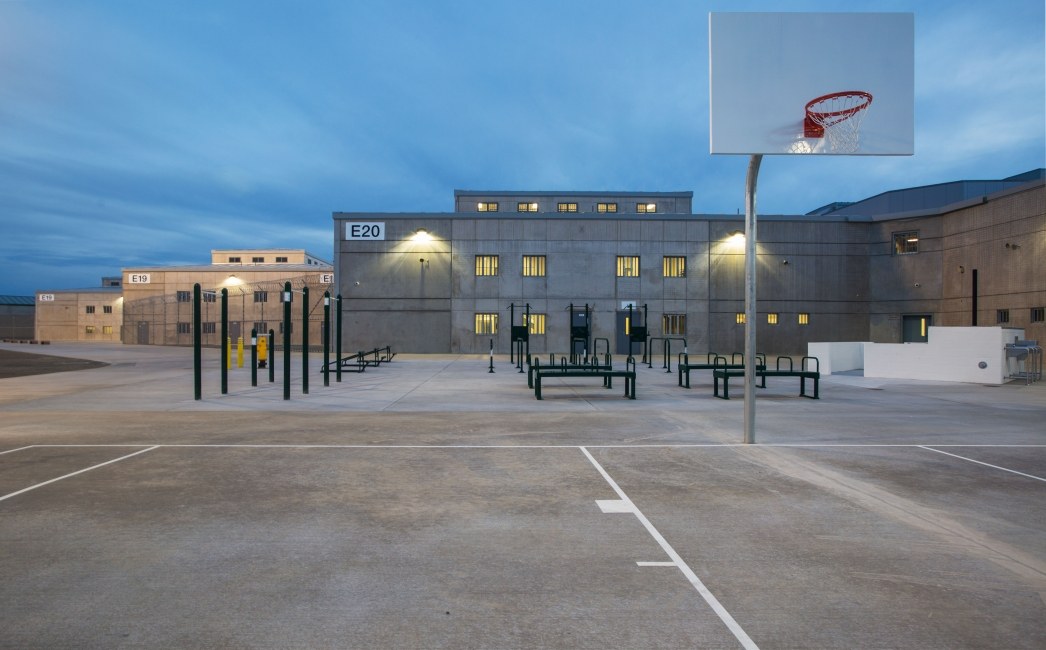
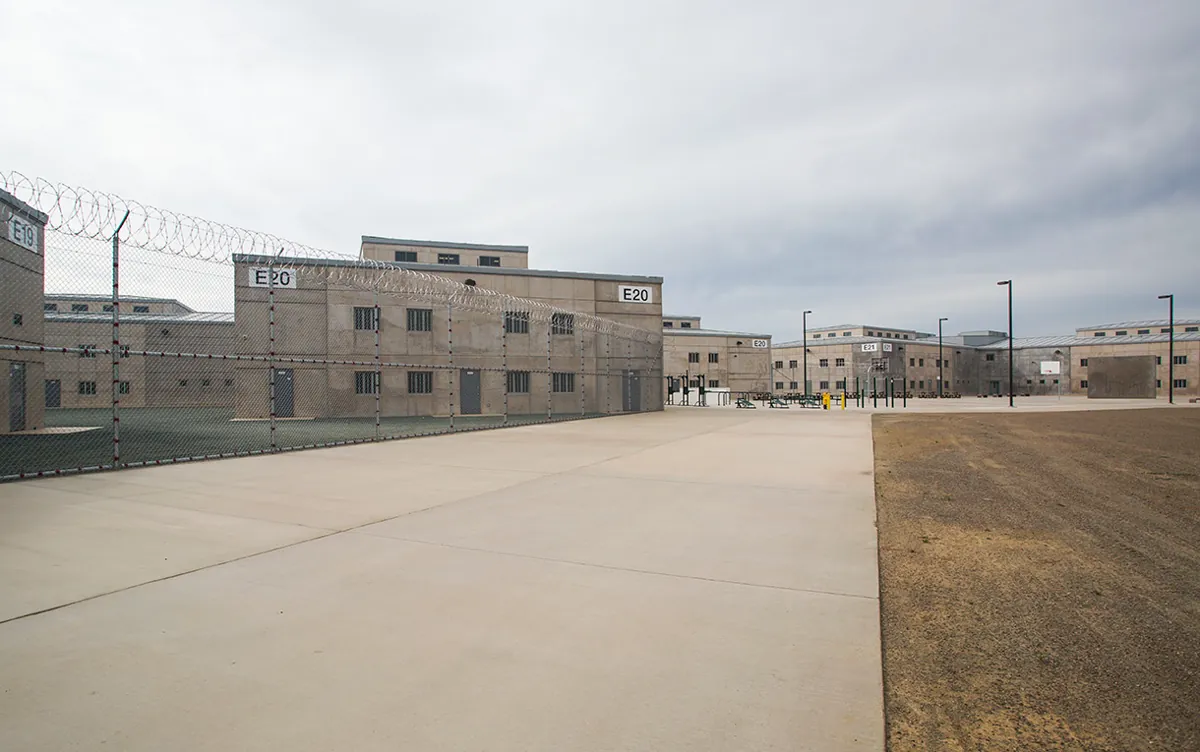
E Yard, Mule Creek Infill Complex: units E19 and E20.
Not a single yard: Mule Creek is a correctional campus of six separately controlled facilities, each with its own housing, yard, dining, education, clinic and programming. Effectively several prisons on one site.
Main complex
Facilities A, B and C are the original secure prison. Each has five 270-degree two-tier cell buildings around its own yard, roughly 50 cells per tier, generally double occupancy. Units run A1-A5, B6-B10, C11-C15.
Infill complex
Facilities D and E form the Mule Creek Infill Complex, opened around 2016 with its own double fence and electrified perimeter, essentially a second prison beside the first. Units D16-D18 and E19-E21. Each building has four pods of dorm-style rooms, about 44 rooms holding up to six people, roughly 264 per building. About 80 acres, designed for around 1,584 Level II people.
Minimum support
Facility M (MSF) sits outside the main secure perimeter behind a single barbed-wire fence: two two-story open dormitories plus the institution Firehouse, with its own dining, education, clinic, library, canteen and laundry.
Restricted housing
What was Administrative Segregation is now handled under CDCR's Restricted Housing Unit (RHU) framework. CDCR replaced the older ASU/SHU terminology from 2023, with further RHU regulations effective May 1, 2026. MCSP's principal documented segregation location is Facility C, Housing Unit C12, which also had separate holding cells and its own segregated recreation area with individual exercise enclosures.
The RHU model sets a standard target of at least 20 hours of out-of-cell time each week, plus rehabilitative programming, education, legal access, mental-health services and periodic review of continued placement. Credits can reduce the RHU term, though not the underlying sentence. People in restricted housing are generally limited to non-contact visits.
Mule Creek State Prison photos
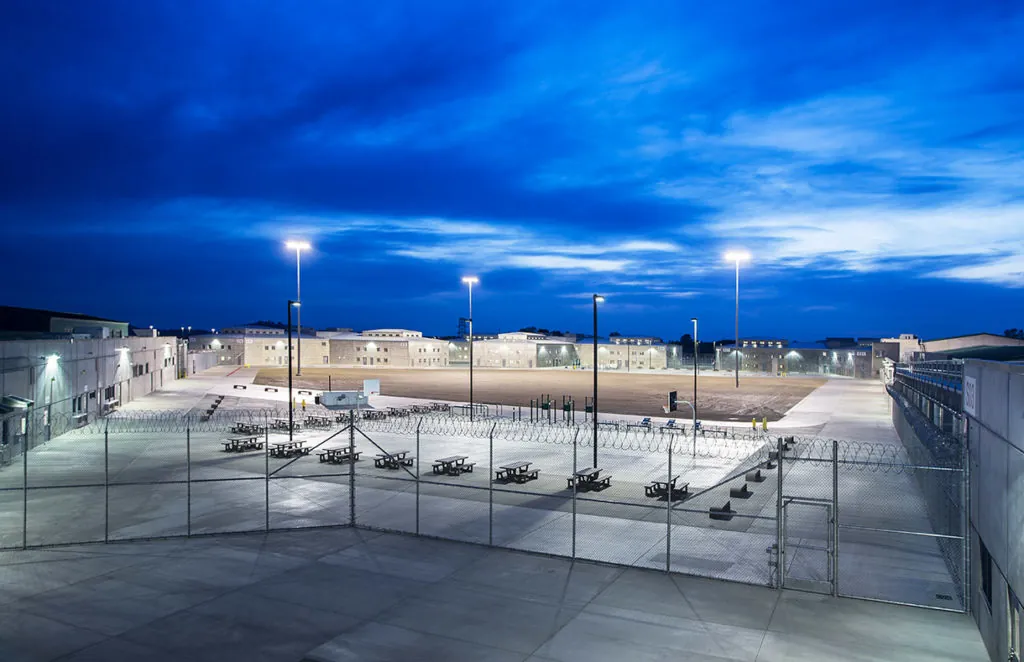
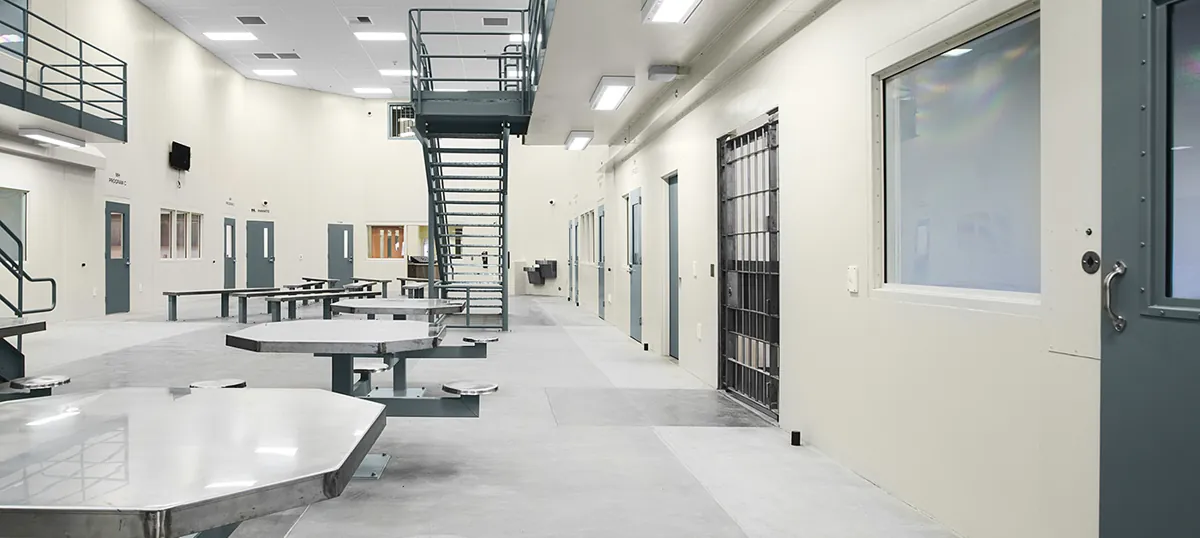
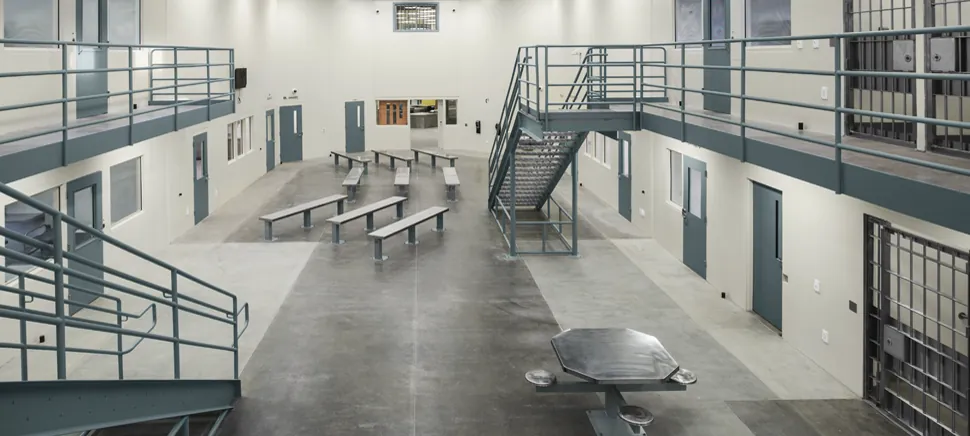
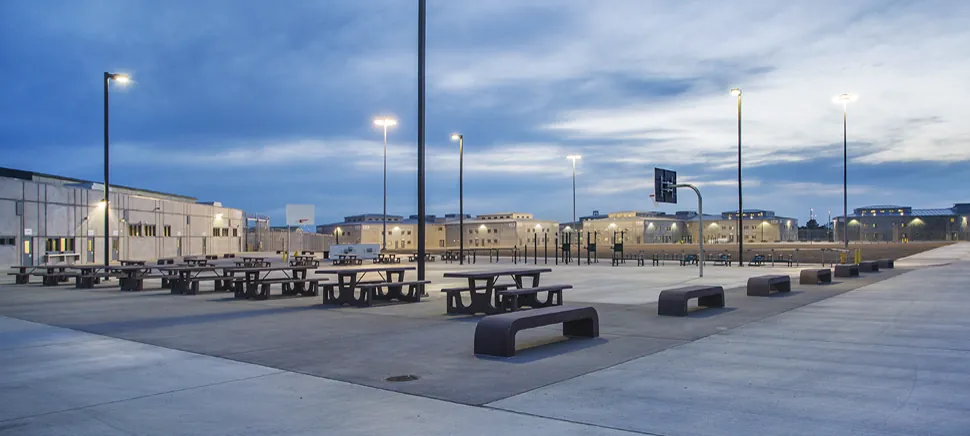
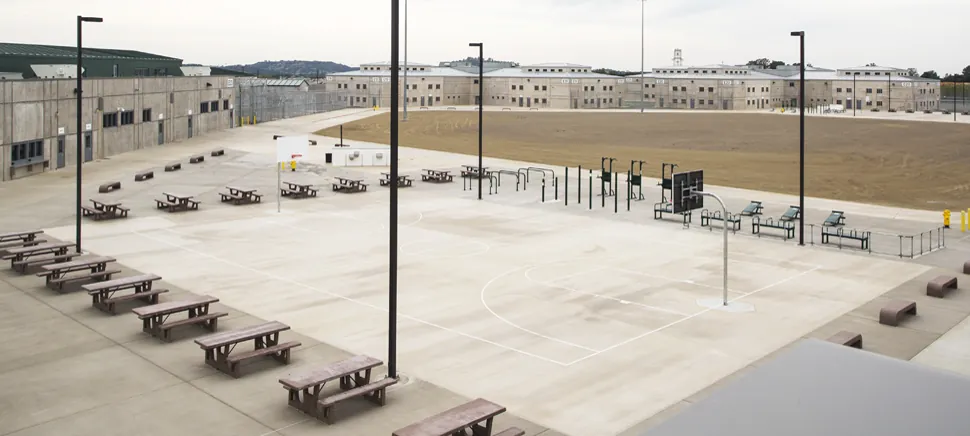
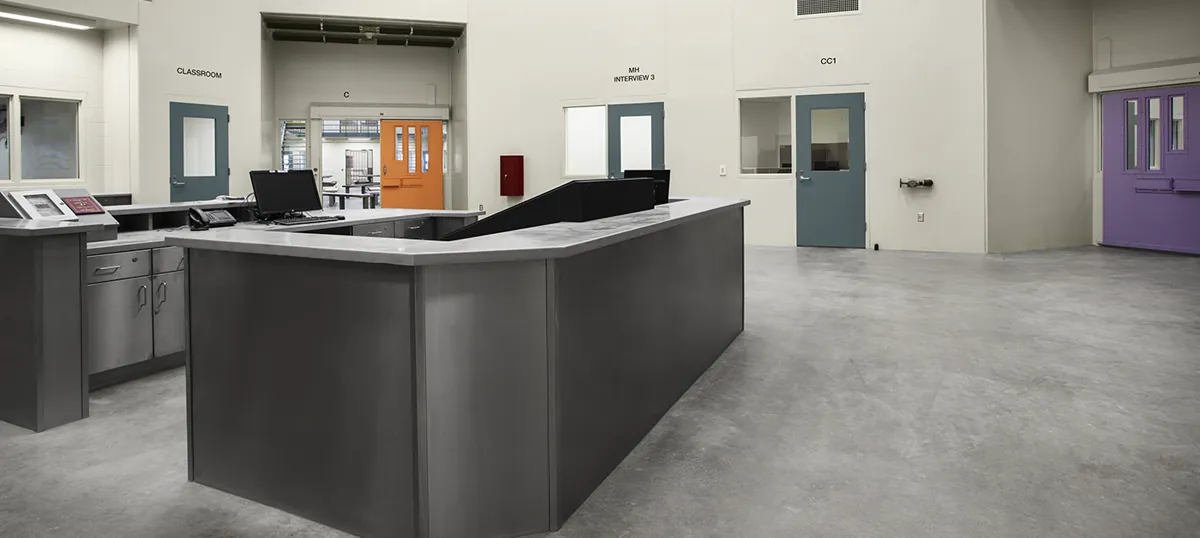
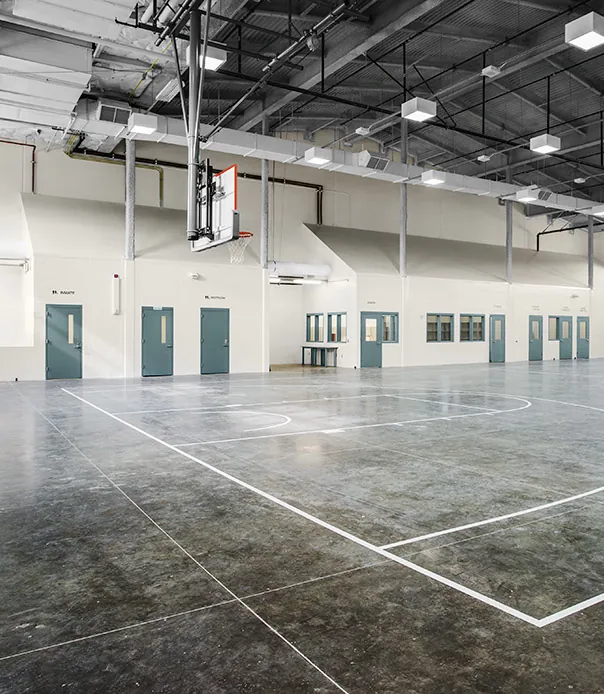
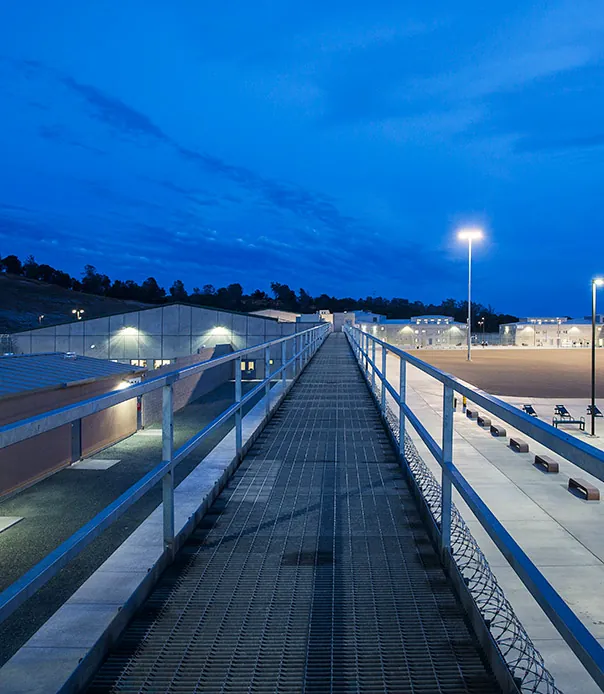
These photos show housing-unit interiors, recreation yards, buildings and shared spaces at Mule Creek State Prison.
Recreation yard and housing buildings after dark.Housing-unit dayroom and circulation space.Second-level view across a housing-unit dayroom.Outdoor recreation yard at dusk.Daylight view across the recreation yard and housing buildings.Building E20 and the adjacent secure yard.Control and interview area inside the institution.Indoor gymnasium and basketball court.Raised catwalk overlooking the recreation yard.
Health care, programs and release preparation
These services differ by institution. The details below describe what this prison reports, not a systemwide promise that every person qualifies for every program.
Health care
A substantial on-site health system rather than a basic infirmary: primary care, chronic-disease management, medication administration, nursing, dental, nutrition, emergency triage and specialty referral.
Capacity: Correctional Treatment Center beds: 2. Mental Health Crisis Beds: 8. A Triage and Treatment Area handles urgent and emergency cases on site.
Mental health: CCCMS outpatient care and the Enhanced Outpatient Program (EOP), including in restrictive housing. Psychiatric evaluation, treatment plans, medication management, crisis intervention and suicide-risk assessment. Referrals are emergent (immediate), urgent (about 24 hours) or routine (about five working days).
Disability: Roughly 943 Disability Placement Program patients and 79 Developmental Disability Program patients recorded in the 2024 capacity assessment.
Substance use: About 909 people, roughly 23 percent of the population, were actively receiving Medication-Assisted Treatment through Integrated Substance Use Disorder Treatment.
Oversight: Medical care at MCSP returned to state oversight on December 8, 2023 as part of CDCR’s delegation process. This is an institutional milestone rather than a day-to-day family service fact.
Important context. MCSP is NOT a designated prison medical center like California Medical Facility or California Health Care Facility. It handles substantial chronic care, outpatient psychiatric care and short-term crises on site; more intensive inpatient or specialty treatment means transfer elsewhere in the CDCR system.
Education, training and work
Academic education, college, career-technical training, prison industries, substance-use treatment, self-help and reentry programming. Academic work runs through Creekside Adult School: adult basic education, literacy, GED and high-school equivalency, continuing education, postsecondary study, student support and library services.
College: Through the Transforming Outcomes Project, Sacramento State University runs a bachelor’s program at Mule Creek. In June 2026, 24 students graduated with BAs in Communication Studies; 22 graduated with honors, including 11 summa cum laude. Folsom Lake College has taught college courses inside C and E Yards.
Career technical: Building Maintenance; Computer Related Technologies (OSRT); Electronics; HVAC; Welding. These are classroom and shop courses that teach a trade.
Prison industries: CALPIA: Data Entry, Clothing and Fabric, Food and Beverage Packaging, Commercial Laundry, Healthcare Facilities Maintenance, and historically coffee roasting with Specialty Coffee Association certification. In September 2024, 45 participants received certifications or apprenticeships. CALPIA is paid industry work and training, distinct from CTE.
Recovery: AA, NA, Criminals and Gang-members Anonymous and its reentry track, Christian 12-Step, Celebrate Recovery Inside, CARE, Al-Anon, Self-Awareness and Recovery.
Self help: GRIP, Alternatives to Violence Project, anger management, victim awareness, conflict resolution, writing and self-exploration.
Special: Veterans Support, Lifers Support, dog and service-animal programs, Arts in Corrections, juvenile diversion.
Seminary: Mule Creek launched a seminary bachelor’s degree program with community partners in October 2024. CDCR described it as the first of its kind in the California prison system.
Media program: The San Quentin Rehabilitation Center Media Center, opened April 2026, serves media-focused programming at several institutions including MCSP.
Important context. SB601 reporting showed more than 1,800 academic students enrolled during parts of 2020. That is a historical figure, not a current enrollment count.
Preparing for release
Formal release preparation covering identification, employment, housing, supervision requirements, treatment continuity and community reintegration.
Programs: Transitions Program: CDCR’s structured prerelease curriculum on employment readiness, budgeting, housing, transportation, parole expectations and community resources. California Identification Card Program, so people do not leave without usable ID. CDCR-funded reentry and self-help programs covering employment preparation, cognitive-behavioral work, recovery support and mentoring.
Continuity: Substance-use treatment and MAT can be planned into community care. CCCMS and EOP patients generally get discharge planning to connect them to community mental-health care and medication. Parole release planning covers residence, assigned parole unit and reporting instructions.
Documents: Depending on eligibility, prerelease staff may help with identification, Social Security documentation and Medi-Cal or health-care linkage.
Important context. Release preparation does NOT mean CDCR finds anyone a job or permanent housing. It builds the release plan and makes connections; outcomes depend on eligibility, county, parole status, family resources and what community programs exist.
Choose the right contact for a concern
Immediate danger
If you believe someone at Mule Creek faces imminent bodily injury, suicide or homicide, call (209) 274-4911 and ask for the Watch Office. Do not use an email or complaint form for an emergency.
For an urgent change in the person’s medical condition, call Mule Creek’s Patient Health Care Inquiry line at (916) 478-8770. This is not the emergency route. Staff need the patient’s authorization before sharing protected medical information. For a nonurgent authorized health inquiry, email m_CCHCSPHCI@cdcr.ca.gov or write to CCHCS Health Care Correspondence and Appeals Branch, P.O. Box 588500, Elk Grove, CA 95758. Do not send medical records or private health information to Jail411.
If an immediate family member has died, is seriously ill or has been in an accident, call the main switchboard at (209) 274-4911 and explain the emergency. Ask for the chaplain or correctional counselor. If unavailable, ask for the program lieutenant, then the watch commander. Staff verify emergency messages; the switchboard does not provide a direct call to the incarcerated person.
Contact the CDCR Ombudsman at (916) 445-1773, use its online contact form or write to P.O. Box 942883, Sacramento, CA 94283-0001. The Ombudsman handles complaints and referrals. It is not emergency dispatch, does not override prison officials and does not conduct formal investigations.
Check the new prison before visiting or sending anything
Use CDCR’s CIRIS search to find the current prison. If you cannot locate the person, call CDCR’s Identification Unit at (916) 445-6713. Ask the destination institution for the housing and mailing address before sending a letter, book or package.
Your visiting approval carries to another institution for the same person if your approval status is unchanged. That does not transfer a booked appointment. Contact the new visiting office to check its schedule, visiting status and reservation process. Changes to your contact details or arrest history may require a new questionnaire.
Check the new institution’s phone and tablet provider before paying for services. Mule Creek uses Securus, but a receiving institution may still use ViaPath until its transition. Do not assume the former mailing address, visit reservation or account setup works at the new prison.
These cover the same ground across every facility in the directory, which is what you want if the person may be moved, or if you are helping someone in a different state.
Visiting
Visitor approval, identification and planning your visit.
Jail411 is an independent information resource for families and friends. We are not a government agency, jail operator, law firm or live custody-records service.
You cannot call into a housing unit. The incarcerated person initiates the call. Standard audio calls from institution phones and tablets are free to both parties.
Can Jail411 tell me if someone is in custody right now?
No. Jail411 does not hold live custody records. Use the official locator for the county, state, federal or ICE system that has the person; start here if you do not know which.
What should I do if someone is transferred from Mule Creek?
Use CIRIS to confirm the new prison, then contact that institution for its visiting schedule, reservation process, correct mailing address and communication provider. Your visiting approval for the same person carries over if your approval status is unchanged, but a booked appointment does not transfer.
What should I confirm before visiting?
The person’s current facility, the visiting schedule, approval requirements, accepted identification and arrival instructions. Check the facility page and its official sources before you travel.
What if I find something that needs correcting?
Send us the page and the detail that needs attention. Include the official source when you have one. Do not send private booking documents or other sensitive personal information.
More help finding the right place
YOUR FAMILY REFERENCE
Plan the next step.
Practical guides for calls, visits, mail, money and release.