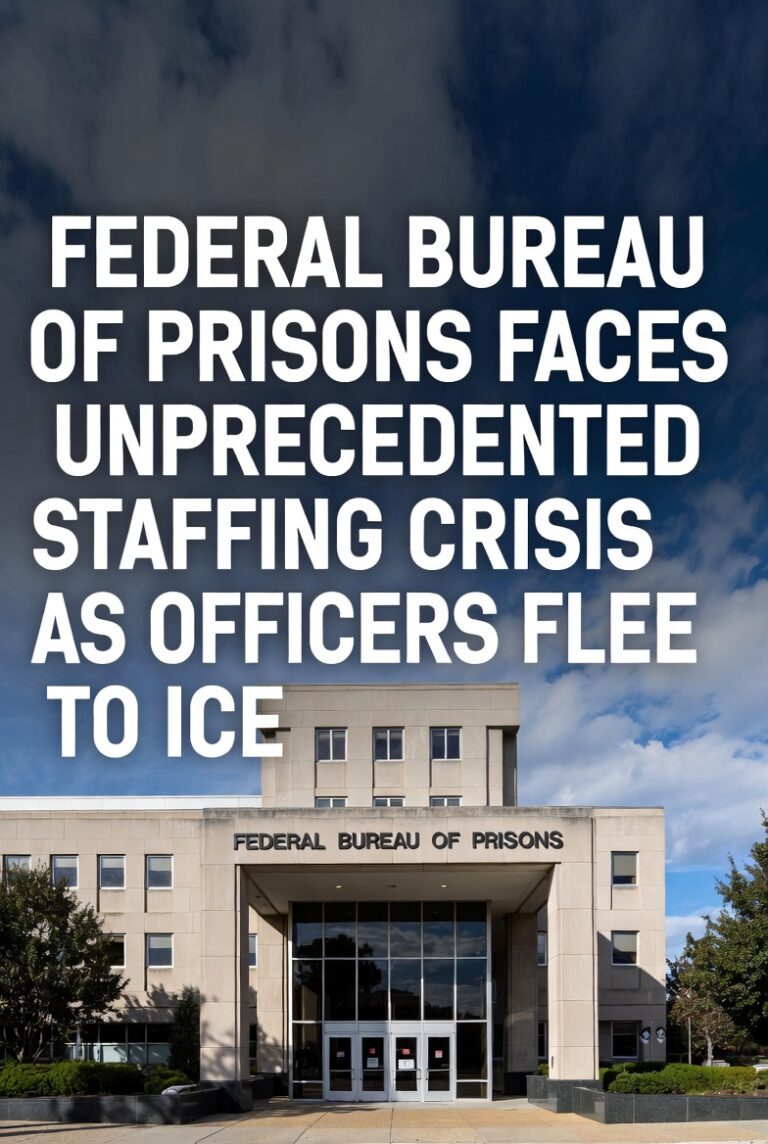
The Federal Bureau of Prisons is hemorrhaging experienced corrections officers to Immigration and Customs Enforcement, drawn away by signing bonuses of up to $50,000 and significantly higher starting pay — leaving federal lockups dangerously understaffed and increasingly volatile.
The exodus has accelerated over the past year as ICE more than doubled its officer and agent workforce to support expanded immigration enforcement operations. For veteran corrections officers earning modest federal salaries while working mandatory overtime in chronically short-staffed prisons, the recruitment pitch from ICE has proven difficult to resist.
A System Running on Fumes
Union officials estimate that roughly 40 percent of corrections officer positions at federal prisons remain vacant nationwide. The Bureau of Prisons has seen a 43 percent increase in overtime hours among frontline staff over the past five years, with officers at some facilities routinely working 60-hour weeks just to maintain minimum staffing levels.
The consequences are immediate and measurable. At facilities in Florida, officers report that housing units designed for two-officer coverage regularly operate with a single CO responsible for 120 or more inmates. In Texas, multiple federal correctional institutions have implemented rolling lockdowns — confining inmates to cells for extended periods — not as a disciplinary measure but simply because there are not enough staff to safely operate normal programming.
Programs Gutted by Augmentation
To fill the gaps, the Bureau of Prisons has increasingly relied on a practice known as augmentation — reassigning non-custody staff such as teachers, counselors, case managers, and maintenance workers to fill correctional officer posts. While the practice keeps housing units minimally staffed, it comes at a steep cost to the rehabilitative programming that is supposed to reduce recidivism.
Educational classes get canceled. Vocational training workshops sit empty. Drug treatment programs lose facilitators mid-session. Case managers who should be helping inmates prepare reentry plans are instead walking tiers and conducting counts. The irony is sharp: the very programs designed to make communities safer by preparing inmates for release are being sacrificed to cover shifts that exist because officers have left for other agencies.
Understanding the difference between jail and prison helps clarify why federal prison staffing has such far-reaching implications — these are long-term facilities housing people serving sentences of a year or more, where programming access directly affects outcomes after release.
State Systems Feel the Pressure Too
The staffing crisis is not confined to the federal system. In North Carolina, about one in four state prisons — 14 facilities — have half or more of their correctional officer positions vacant, according to December staffing data. The state’s Department of Public Safety has struggled to compete with private-sector wages and the lure of federal law enforcement positions that offer better pay and benefits.
Similar shortages plague state systems across the South. Georgia has resorted to consolidating inmates from multiple facilities to concentrate available staff. Alabama, already under federal court scrutiny for prison conditions, continues to operate well below minimum staffing thresholds despite repeated judicial orders to address the crisis.
The ICE Pipeline
ICE’s aggressive recruitment of experienced corrections staff makes tactical sense for the immigration agency — these are professionals already trained in detention operations, use-of-force protocols, and facility security. But for the Bureau of Prisons, each officer who leaves represents years of institutional knowledge and training investment walking out the door.
Congressional Democrats have pressed BOP leadership for answers, pointing to what they describe as a self-defeating cycle within the federal government: one agency’s expansion is cannibalizing another’s workforce, creating dangerous conditions in federal prisons while scaling up a detention system that is itself struggling with oversight and accountability.
The Bureau of Prisons has responded with retention bonuses at some facilities and expedited hiring processes, but corrections workforce experts say these measures are unlikely to stem the tide. The fundamental economics — ICE offering $50,000 signing bonuses against BOP’s modest retention incentives — create a gravitational pull that administrative adjustments alone cannot overcome.
Life on the Inside
For the 158,000 people incarcerated in federal prisons, the staffing crisis means longer lockdowns, fewer opportunities to earn good-time credits, reduced access to medical and mental health services, and heightened risk of violence. When units are short-staffed, response times to emergencies increase. Fights that might be de-escalated with adequate staffing instead spiral into serious assaults.
Family members trying to visit loved ones in federal facilities have reported increased cancellations of visitation periods due to staffing shortages, further straining the family connections that research consistently identifies as one of the strongest predictors of successful reentry.
The staffing crisis shows no sign of abating. As long as immigration enforcement continues to expand and ICE continues to recruit from the corrections workforce, federal prisons will remain caught in a competition they are structurally unable to win.
Related on Jail411
- Florida Jail & Prison Directory — Facility information, inmate search, and visitation details for Florida institutions
- Jail vs. Prison: What’s the Difference? — Understanding federal, state, and local detention facilities
- How to Visit Someone in Jail or Prison — Complete guide to scheduling visits at federal and state facilities